
You’ve heard this term everywhere recently. Creator Economy.
On Instagram. On YouTube. In reels. In college seminars. Even your parents are asking about it
now.
But if I asked you right now — what exactly is the Creator Economy? — most of you would say
something like… “it’s about making content and earning money, right?”
That’s not wrong. But that’s not complete either.
And that gap — between what you think it is and what it actually is — that’s exactly where most
people make their biggest career mistakes.
So today, let’s start from zero. No hype. No highlight reels. Just the truth.
Let’s keep it very simple.
For a long time, if you had a skill — say you were a great video editor, a graphic designer, or someone who could teach well — there were only two ways to earn money.
Option 1: Get a job. Work for someone else. Fixed salary. Fixed hours.
Option 2: Freelance. Find clients. Do projects. Get paid.
That was it.
Now something has changed.
Platforms like YouTube, Instagram, and others created a third option.
You can now build an audience directly. And that audience becomes your income. You don’t need a company to hire you. You don’t need clients to give you projects. You build content, a channel, a community — and people come to you. That is the Creator Economy.
In the simplest words: the Creator Economy is a world where your skill, your knowledge, and your personality can directly earn you money — without a middleman.
A motion designer in Chennai posting reels of his work. A teacher making YouTube videos in Tamil. A fitness trainer doing Instagram lives. A developer writing a newsletter about coding.
All of them are part of the Creator Economy. It is not just for entertainers. It is not just for people who dance on reels. It is for anyone who has something valuable to share — and the clarity to share it with purpose.
BRAND INSERT — WHY ViSA IS TALKING ABOUT THIS.
Now, before we go further — let me tell you why we at Video Superstars Academy are talking
about this.
We have made the Creator Economy one of the core pillars of everything we teach here. Not because it is a trend. But because the world is genuinely moving in this direction — and we believe our students deserve to understand it before they enter it.
Here is something that stopped me when I first heard it.
Sam Altman — the CEO of OpenAI — said that in the next few years, we could see a one-person company making one billion dollars annually.
One person. One billion dollars. That is roughly 8,500 crores every year. From one person. Think about that for a second.
AI is making that possible. The tools available today — for creating, marketing, selling, automating — have reduced what used to require an entire team down to what one focused, strategic individual can do alone.
That is the scale of what is coming.
But — and this is important — that same power is also what is making it dangerous for people who jump in without thinking.
Because if you enter this space without a strategy, without clarity, without the right framework — you will spend your best years busy but going nowhere. I have seen it happen to too many talented people.
That is why this series exists. And that is why at ViSA, the most important tool we give our students is not Photoshop. Not Premiere Pro. Not Figma. Not Python.
It is thinking in frameworks.
More on that later in this series. Follow this channel so you don’t miss what comes next. Now — let’s get back to the Creator Economy.
SO IS IT JUST FREELANCING?
Now the question most people ask.
“This sounds like freelancing only. What’s the difference?”
Important question. Here is the honest answer.
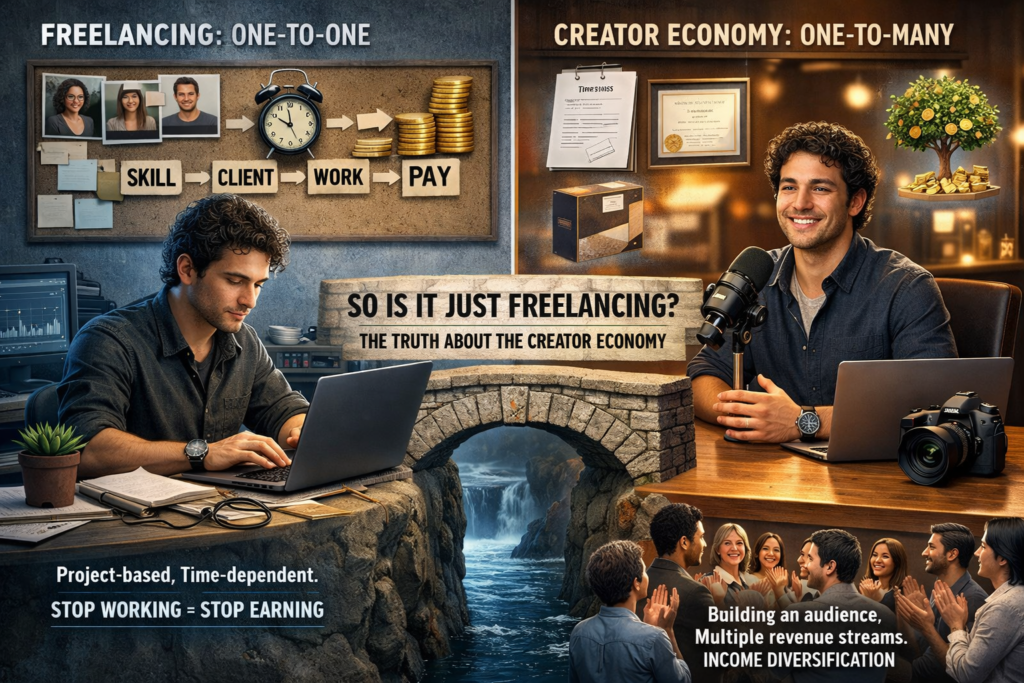
Freelancing: you have a skill → you find a client → you do the work → you get paid → you find the next client.
Your income depends on how many clients you can find and how many hours you can work. The moment you stop working, the income stops. One client leaves — you are back to zero.
Creator Economy: you have a skill → you build content around it → you build an audience → that audience trusts you → and from that trust, you earn in multiple ways. Brand deals. Your own courses. Products. Consulting.
Your audience doesn’t leave when one client leaves.
Here is the key: freelancing is not bad. It is actually how most creators start. It gives you income while you build something bigger.
But freelancing alone — with no plan beyond the next project — is where people get stuck at year two and year three wondering what went wrong.
Freelance with a plan = Creator Economy. Freelance without a plan = just surviving.
That is the distinction.

THE NUMBERS LOOK GREAT. YOUR REALITY MAY NOT
Now let me show you the full picture.
The Creator Economy is genuinely massive. According to a BCG report from 2025, Indian creators influence over 350 billion dollars in consumer spending every year. By 2030, that crosses one trillion. Globally, Goldman Sachs estimates this market will be worth 500 billion dollars by 2027.
The opportunity is real.
But here is the number nobody puts in their motivational post. In India, only 8 to 10 percent of creators are earning meaningful income.
That means 9 out of every 10 people who call themselves creators — are not making real money. 9 out of 10.
Globally, 59 percent of beginner creators have not monetised at all. Not even a rupee.
And it is not just about the money. It takes most creators 5 or more months before their first earning. Those are months of scripting, editing, posting, chasing the algorithm — with zero income. Most people are not mentally or financially prepared for that.
Here is another reality nobody talks about.
When you become a creator, you are not just a creative person. You are suddenly running a small business. You are doing your own marketing, your own negotiation with brands, your own taxes, your own product design. Studies show creators spend 54 percent of their time on non-creative tasks. More than half their time — not creating. Running operations.
Most people sign up to make videos. They don’t realise they are signing up to be a CEO. And then there is the platform problem.
A single algorithm change can cause a 50 to 70 percent drop in your reach overnight. 69 percent of creators report income instability because of this. Your audience lives on a platform you don’t own. One policy change, one update — and years of work can be disrupted in days.
And then there is AI. 91 percent of creators are already using AI tools for editing, writing, designing. If your only value is that you can execute a task — AI is coming for that task. Fast.
So yes — the opportunity is real. But the road is harder and longer than the highlight reels suggest.
WHAT IS ACTUALLY HAPPENING AROUND US
Let me tell you what I see every month.
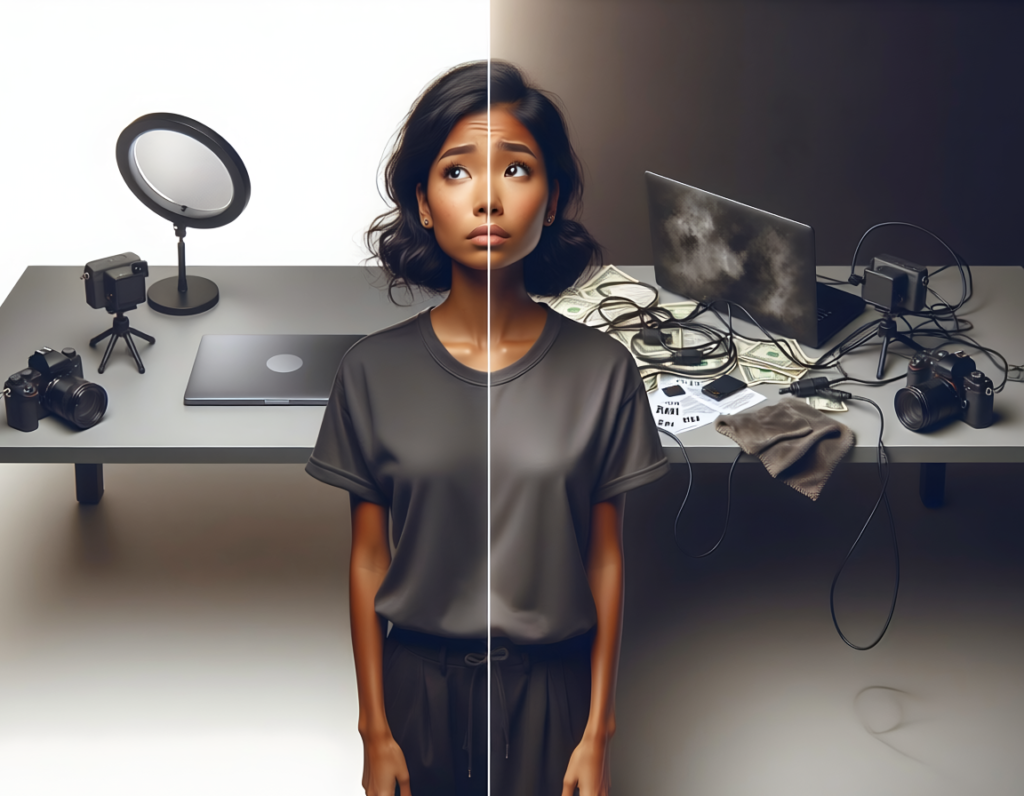
Youngsters — passionate, talented, full of energy — making big decisions.
They quit jobs. Skip placements. Buy a camera, a laptop, editing software, a ring light, a mic. Some set up a full studio at home. With borrowed money. With EMI.
And then they start watching someone — a YouTuber, an influencer, an editor — with lakhs of followers, doing brand deals, travelling, living what looks like a free life.
And they think: if I copy what they are doing, I will get there too.
I understand that feeling completely.
But here is what nobody tells them.
That person built their audience 3, 4, maybe 5 years ago. The platform was different. The competition was less. The algorithm rewarded different things.
You cannot copy someone’s result by copying their current actions — because you are not starting from where they started.
You are starting from today. Today is more crowded. More competitive. It requires more clarity and more strategy than it ever did before.
Copying the what without understanding the why — that is the trap.
SO WHAT CAN YOU ACTUALLY DO?
Now — the part most videos skip.
They tell you the problems and leave you there. We are not going to do that.
Here is what separates the 10 percent who succeed from the 90 percent who struggle.
One — Treat it like a business from day one.
Not a hobby. Not an experiment. A business. That means knowing your audience before you post. Knowing what problem your content solves. Knowing how you will earn — not just from views, but from multiple streams.
Here is a counterintuitive truth: 500 deeply engaged followers can out-earn 50,000 casual ones.
If 500 people genuinely trust you and buy a course, a service, or a product from you — that is real income. Chasing vanity numbers without a monetisation plan is where most people waste years.
Two — Own your audience. Don’t just rent it.
Platforms are real estate you don’t own. Build an email list. Build a community. Give people a reason to follow you beyond a platform. Because when the algorithm changes — and it will — your owned audience stays with you.
Three — Think depth, not volume.
The Creator Economy does not reward the person who posts the most. It rewards the person who is most useful, most trusted, most specific. One deep niche beats ten shallow ones. One loyal community beats a hundred passive followers.
Four — Play the long game.
This is a marathon. Not a sprint. Not a viral moment. Consistency over years builds what virality cannot — credibility. The creators who are winning today started 3, 4, 5 years ago and kept going when nobody was watching.
Five — Think before you create.
This is the one that changes everything.
Most people ask: what should I make?
The right question is: why will someone care about what I make?
That shift — from execution thinking to strategic thinking — is what separates creators who build something real from those who stay busy and broke.
HOW SPARK FITS INTO ALL OF THIS
At ViSA, we built a framework called SPARK specifically for this.
SPARK is not a software. It is not a course module. It is a way of thinking.
It trains you to ask second-layer questions before you create anything.
Not just: What video should I make? But: Who is watching this? What do they feel after? What
decision does this lead to?
Not just: How do I get more followers? But: What kind of creator do I want to be known as — and am I building toward that with every single post? This is the thinking the Creator Economy actually rewards. Not just content. Intentional content.
AI can generate a video. AI can write a script. But AI cannot understand why a specific audience in your city trusts a specific kind of voice. That cultural, emotional, strategic intelligence — that is yours. But only if you train it.
SPARK is how we train it. Every student at ViSA — whether they are learning video editing, motion graphics, or building their personal brand — goes through SPARK first. Before they touch any software. Before they
start any project.
Because we have seen too many talented people fail — not because they couldn’t do the work.
But because they never stopped to think about why they were doing it.
So let me bring it all together.
The Creator Economy is real. The opportunity is real. India alone is heading toward a trillion dollar creator-influenced economy by 2030.
But the road is longer, harder, and more strategic than most people are told.
The ones who win are not the ones with the best camera or the most followers. They are the ones who think clearly, build deliberately, and stay consistent long after the excitement fades.
That is what this series is about.
In the next article, we will go deeper — into why most creators never make real money, and the specific mindset shifts that change that.
If this content gave you even one new way to think about your creative career — share it with
someone who needs to hear it.
Follow this channel. Because we are just getting started.