
A few years ago, being good at execution was enough.
If you could design well, edit quickly, run ads, write copy, or build websites, you had value. Companies hired you because you could do the work.
But the market is changing.
Today, AI can generate ad copy, edit videos, create design layouts, build landing pages, and suggest social media posts — faster than any human.
This does not mean jobs are disappearing. But it means something important: execution alone is becoming less valuable.
The people who will stay relevant are not just the ones who can do the work. They are the ones who can decide what work should be done.
That is the shift from executor to strategist.
The Difference Between an Executor and a Strategist
An executor is valuable because they can complete tasks. A strategist is valuable because they can shape direction.
Executors ask: What do you want me to do? Which software should I use? What should this look like?
Strategists ask: What is the real goal? Why is this not working already? What are we missing? What should we do differently?
That difference changes careers. Because companies can teach people software. It is much harder to teach judgment, insight, and decision-making.
The Career Split Is Already Happening
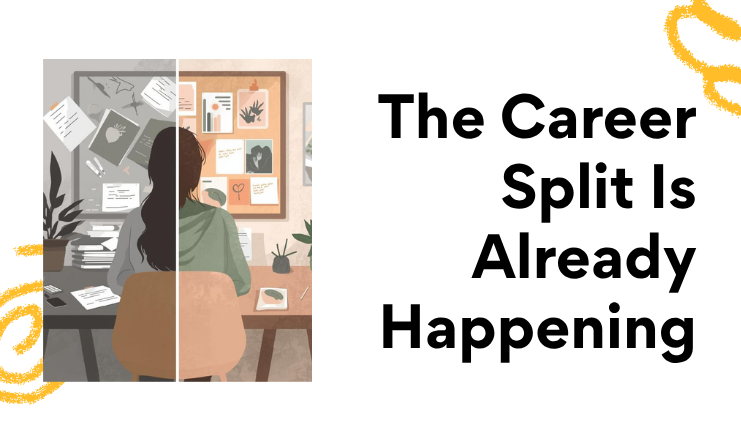
Imagine two people joining the same company, in the same role, on the same day. Both equally talented. Both know the same tools. Both work hard.
Five years later, their careers look very different.
The first person becomes a senior designer, senior editor, or senior marketer. Reliable. Skilled. Hardworking. But still waiting for someone else to define the brief.
The second person becomes a creative lead, brand strategist, product head, or consultant.
Why? Because they learned how to think before they executed. They became the person others trust to make decisions.
That is what leadership usually is. Not just doing good work. Deciding what good work should look like.

The Roles That Are Becoming More Valuable
In almost every industry, the most valuable roles are shifting away from pure execution toward strategic thinking.
In design, that means moving from graphic designer to brand strategist, UI designer to product thinker, video editor to creative director.
In marketing, that means moving from ad executor to campaign strategist, social media manager to brand builder, content creator to content director.
The technical skill still matters. But it is no longer enough by itself. The higher-value role is always the one closer to decision-making.
Here is the pattern companies follow when promoting people:
- Junior roles — Execution-focused: “Can you follow this brief?”
- Mid-level roles — Refinement-focused: “Can you improve this draft?” ● Senior roles — Strategy-focused: “Can you decide what we should create and why?” ● Leadership roles — Direction-focused: “Can you set the vision and guide the team?”
SPARK thinkers skip levels. Not because they are more talented. Because they think at a higher layer.
AI Has a Fatal Flaw
AI is very good at following instructions. It can generate options, speed up repetitive work, and automate basic execution.
But AI has one flaw it cannot overcome: it has no intent.
AI does not know why a design needs to feel sad. It does not know why a video needs silence at that exact moment. It does not know why removing an element makes the message stronger. AI only knows patterns. It generates options based on what it has seen before.
It cannot judge. It cannot decide. It cannot refine with conviction.
AI generates options. Humans provide judgment.
And judgment — the ability to choose what is right, not just what is possible — is the most valuable skill in an AI-powered world.
This is also why AI needs SPARK thinkers. AI is a multiplier — give it average thinking and it gives you average execution at speed. Give it SPARK thinking and it builds something remarkable.
Here is the same brief, handled two ways:
Without SPARK: “Create a poster for a mental health event.” AI output: a calming blue poster with a brain illustration and an inspirational quote. Technically correct. Completely forgettable.
With SPARK: “Create a poster that makes isolated students feel understood, so they attend a mental health event. The real problem is not awareness — it is stigma. Avoid clinical imagery. Show human connection.” AI output: a simple image of two silhouettes sitting together. One line: “You are not the only one. Let us talk.”
What changed? Not the AI. The thinking behind the prompt.
The Three Traps That Keep People Stuck in Execution
If the path is so clear, why will most professionals get left behind?
Because thinking is uncomfortable. And most people unconsciously avoid it.
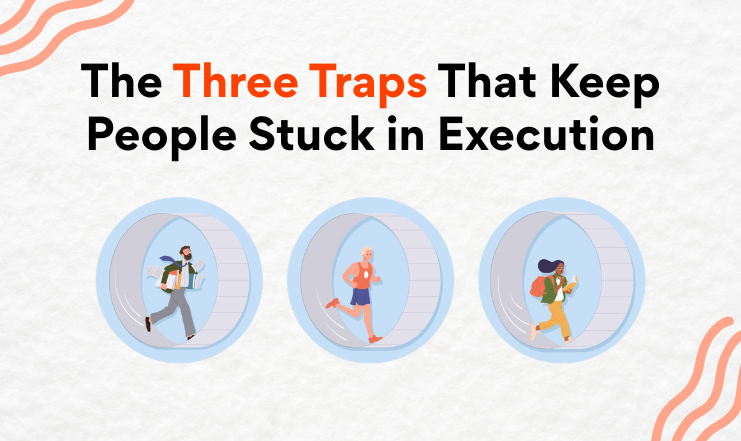
Trap 1: The Comfort of Tools Opening software feels like work. Moving pixels feels productive. Stopping to ask “What is the real problem here?” feels like doing nothing. So most people choose the busywork of execution over the hard work of thinking. They stay busy, deliver on time, and wonder why they are not advancing.
Trap 2: The Fear of Being Wrong We copy what is trending. We follow the brief exactly. We think: “If I just execute well, I will not get criticised.” But safety is exactly what AI automates first. If your strategy is “do what everyone else does, but slightly better,” you are competing with machines — and you will lose.
Trap 3: Rushing to Finish The “get it done” mindset is a relic of the assembly line. In an AI world, getting it done takes five seconds. The value is no longer in finishing. It is in defining what is worth starting. Most people skip intent, skip spotting the real problem, and stop at V2 when V3 would have been the one that stood out.
The Five Skills That Make Someone Irreplaceable
The people who stay valuable over the next decade will be strong in five areas — and these are exactly what SPARK trains:
Problem Diagnosis — Most people solve visible problems. Valuable people solve the real problem underneath. (Spot)
Critical Thinking — Most people accept the obvious answer. Valuable people question it. (Probe)
Cross-Field Thinking — Most people stay inside their own category. Valuable people borrow ideas from different fields. (Adapt)
Clarity — Most people create more complexity. Valuable people organise complexity into something simple and clear. (Reconstruct)
Judgment — Most people stop when something is finished. Valuable people know the difference between finished and good. (Keep Iterating)
These are the skills companies promote people for. Because these are the skills that drive decisions.
The Real Goal Is Not Just to Get Hired
Many students focus only on getting their first job. That matters.
But the bigger question is: what kind of career are you building?
Do you want to spend the next ten years waiting for instructions? Or do you want to become the person trusted to give them?
One follows direction. The other creates it.
The next decade will reward people who can think, not just do. People who can see what others miss, connect ideas, question assumptions, and make strong decisions under uncertainty.
Those people will not just survive the AI era. They will become more valuable because of it.
Because when everyone has access to the same tools, the biggest advantage is not software. It is the ability to think when the software is not enough.
That is what SPARK trains. Not just better execution — better judgment.
Explore the SPARK series:
- Why Tool Skills Alone Are Not Enough Anymore
- The Rise of the Knowledgeable Rebel — Why the Best Creatives Question Everything
- Surface Thinking vs Second-Layer Thinking: Which One Are You Using? ● What Is SPARK? A Thinking System, Not a Creative Trick
- What Are Companies Actually Hiring For Now?
At Video Superstars Academy, SPARK is how students train this kind of second-layer thinking deliberately — so they do not just learn tools, but learn how to think beyond them.