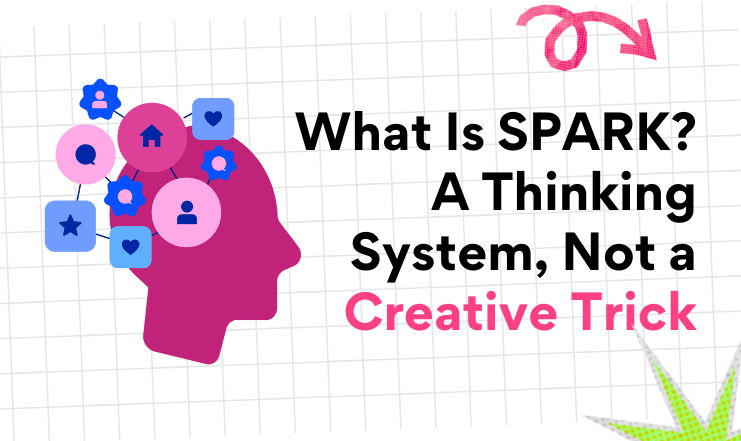

Most people think creativity is something mysterious.
They believe some people are simply born with better ideas. They assume creativity is about talent, instinct, or waiting for inspiration to arrive.
But the truth is simpler.
Most great work does not come from random inspiration. It comes from a better way of thinking. That is what SPARK is.

The Fire Is Already Inside You
Start with the word itself: SPARK.
A spark has two meanings. The first is literal — the tiny burst of light when flint strikes steel, when friction creates fire. The second is metaphorical — that sudden flash of insight, the idea that seems to appear out of nowhere.
But here is what most people miss: sparks do not come from nothing.
A spark only appears when there is already a fire burning inside. It needs air. It needs motion. It needs someone to blow on the embers deliberately. Without that effort, the fire just smoulders. No light. No heat. No spark.
You already have the fire. You have ideas, instincts, creative impulses, the ability to see patterns and make connections. But most of us never blow on it. We let it sit there, barely glowing, waiting for permission or the perfect moment.
Creativity is not magic. It is a fire that needs to be kindled. And SPARK is how you learn to kindle it deliberately — until the sparks become consistent and the fire burns bright enough to light up everything you create.
What SPARK Really Is
SPARK is not a creativity trick. It is not a brainstorming method. It is not a list of hacks to make your work look more original.
SPARK is a thinking system — a repeatable loop that turns creative instincts into strategic decisions.
It is how you move from:
“This feels right” → “This solves the problem because…” “I like this idea” → “This idea works because…” “It looks good” → “It achieves the goal because…”
That is the difference between instinct and strategy.
Think of it this way. A musician has instincts about melody. But they also understand scales, rhythm, and harmony. Those structures do not limit them — they free the musician to make intentional choices instead of random ones. SPARK is the same. It is the structure that lets your creative instincts become strategic decisions.
In short: SPARK is second-layer thinking made repeatable.
Where SPARK Came From
SPARK was not built in a workshop. It came from a real problem.
For fifteen years, a creative training business ran smoothly. Students learned tools, built portfolios, got hired. Then AI arrived. The market shifted.
Most competitors responded with surface thinking: add more courses, increase marketing spend, drop prices. All reasonable moves. All solving the visible problem — “we are losing students.”
But the second-layer question was different: Why are students hesitating to enrol?
Not because placements dropped. Not because competitors were cheaper. But because students did not believe that learning tools would keep them relevant five years from now. They did not need another software course. They needed to learn how to think — so they could adapt as the industry changed.
That is when SPARK was born. Not as a response to competitors, but as an answer to what students actually needed: a thinking system that makes them valuable regardless of which tools or trends dominate.
A Story That Shows How SPARK Works
Imagine a college struggling to get students to attend a career seminar.
The obvious solution: make a better poster. So the team creates a colourful design — speaker photos, event details, bold fonts, headline: “Career Seminar 2026 – Register Now.” The poster looks professional. Nobody comes. They make the logo bigger, change the colours, add more text. Still nothing.
Because the problem was never the poster.
The real problem is that students do not believe the seminar is worth their time. They assume it will be boring, generic, another lecture that changes nothing.
That is where SPARK begins. Not with the design. With the thinking.
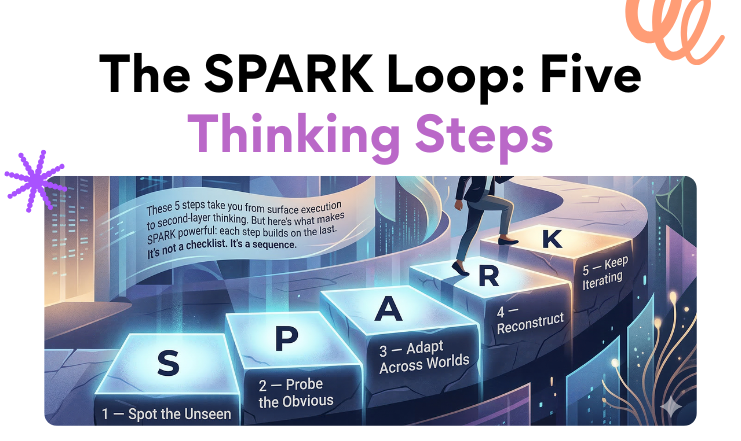
The SPARK Loop: Five Thinking Steps
S — Spot the Unseen
Spot means seeing the real problem, not the visible symptom. In this case, the visible problem is low attendance. But the deeper problem is lack of belief — students do not think the seminar will help them. That is what needs to be solved. Most people stop at what is visible. SPARK teaches you to spot what others miss.
P — Probe the Obvious
Probe means questioning the assumptions everyone else is accepting. Most seminar posters use the same formula: big speaker photo, event date, generic headline, corporate design. But what if those things are exactly why people ignore them? What if students do not need more information — they need emotional relevance?
Instead of “Career Seminar 2026,” the poster says: “The skills that got people hired five years ago are not enough anymore.” That is Probe. Questioning the obvious before committing to a solution.
A — Adapt Across Worlds
Adapt means borrowing principles from unrelated fields. Movie trailers create curiosity before they reveal details. Social media hooks work because they create tension before resolving it. So instead of giving everything away on the poster, the team creates intrigue.
The message becomes: “What if the biggest thing holding your career back is not your talent — but the way you think?” Now people stop. Now they are curious. That is adaptation — taking a principle from one world and applying it in another.
R — Reconstruct
Reconstruct means organising everything into a stronger, clearer solution. Instead of a cluttered poster with too much information, the team strips it down. One headline. One image. One idea. One call to action.
The final poster: “The future does not belong to the people who work the hardest. It belongs to the people who think differently.” Then below: “Join the seminar that helps you stay valuable in the AI era.” Not adding more. Organising better.
K — Keep Iterating
Most people stop too early. They make Version 1 and assume they are done. SPARK teaches you to keep improving. Maybe the first version feels too long. The second too serious. The third is finally clear. Great work rarely looks perfect on the first attempt. It gets sharper through deliberate iteration.
What SPARK Is Not
SPARK will not give you the answer. It will teach you how to find better answers. It will not hand you a solution. It will show you how to question your way to stronger solutions. It will not make decisions for you. It will train you how to make decisions with confidence.
This is important to understand. SPARK is not a formula that produces guaranteed outputs. The best creative work does not come from following steps mechanically. It comes from thinking deeply, questioning boldly, and deciding clearly. SPARK trains how you think — not what you make.
Why SPARK Matters More Than Ever
Today, tools can generate ideas quickly. AI can create options, make content, and imitate styles.
But tools still struggle with understanding the real problem, questioning assumptions, connecting ideas across different fields, and deciding which direction is strongest.
That is still human work. And that is why SPARK matters — because SPARK is not about competing with AI. It is about becoming the person who decides what AI should help create.
SPARK is also not just for creatives. It is useful whenever you need to solve a problem — for founders building products, marketers creating campaigns, designers making meaningful work, and leaders making better decisions. Because the real goal is not just better work. It is better thinking.
The Real Promise of SPARK
SPARK does not guarantee success. It does not magically make someone talented.
But it gives something more useful: a repeatable way to think. A system for making better decisions. And when you make better decisions consistently, better results follow.
Because in a world where everyone has access to the same tools, the people who win will not be the ones who know the most software. They will be the ones who know how to think when the software is not enough.
That thinking does not develop by accident. It develops through practice — through a system applied again and again until it becomes your default.
SPARK is that system.
Explore the SPARK series:
- Why Tool Skills Alone Are Not Enough Anymore
- The Rise of the Knowledgeable Rebel — Why the Best Creatives Question Everything
- Surface Thinking vs Second-Layer Thinking: Which One Are You Using? ● From Executor to Strategist: How SPARK Helps You Stay Relevant in the AI Era ● What Are Companies Actually Hiring For Now?
At Video Superstars Academy, SPARK is how students train this kind of second-layer thinking deliberately — so they do not just learn tools, but learn how to think beyond them.