
From a simple chatbot to a full-time teammate in your marketing workflow.
For most of the past year, “AI in marketing” has been a big, vague topic. Everyone’s talking about it — but very few people are being specific about what AI they’re using and how they’re using it.
This post is about one tool: Claude — and how it’s becoming a daily work partner for performance and growth marketers. Not just a tool you open to brainstorm ideas, but something closer to a flexible teammate who helps you think, research, write, and report.
Anthropic (the company that built Claude) designed it to be a space to think and work — not just a chat window you close after one question.
When marketing teams start treating Claude that way, everything about how they work begins to change.
From Chatbot to Teammate
Most marketers still use Claude the way they use Google — type something in, get something out, close the tab.
But Claude is built for more than that. You can keep context across a long session, build on previous outputs, and take a messy, half-formed problem and slowly turn it into something structured and usable.
In practical terms, that means you can assign Claude to a specific part of your marketing workflow — whether that’s research, content, or reporting — and treat it like someone you’re actually collaborating with, not just querying.
That shift in mindset is where the real change begins.

1. Audience & Keyword Research
Research is where Claude becomes genuinely powerful — if you use it with intention.
Most performance marketers know the frustration: you have customer reviews, NPS survey responses, competitor pages, Reddit threads, and keyword data spread across a dozen tabs. You’re trying to find patterns. You’re trying to understand what customers actually want and how they talk about it. But it takes forever, and the output is usually scattered notes that are hard to turn into a strategy.
Claude changes that workflow. Here’s how:
Read full sources, not just headlines. You can paste in long reviews, export files, or survey responses and ask Claude to actually read and process them — not just skim the surface. It works through the full content the way a diligent analyst would.
Find real customer language. Claude pulls out the exact phrases, pain points, and emotional triggers that show up in reviews, comments, and feedback. This is the kind of language that makes your ads, landing pages, and content actually resonate — because it comes from real people, not a copywriter guessing.
Build structure from patterns. Claude can take a pile of themes and cluster them into campaign angles, content pillars, and ad groups — organized around how people actually think and search, not just a flat list of keywords.
This is a step up from regular keyword tools. You’re not just finding what people search for — you’re understanding why they search for it and what they’re really trying to solve.
What changes in your day-to-day
Without Claude, this kind of research looks like: 20 open browser tabs, screenshots saved to a folder, notes split across Notion, Google Sheets, and Slack, and hours spent trying to stitch it all together into something actionable.
With Claude, you end up with a clean, structured research document — ready to plug directly into a brief, a media plan, or an SEO strategy. Work that used to take half a day gets done in under an hour, and the output is more useful.
2. Creative That Learns From Data
Claude also changes how teams handle ad creative and content — and this is where it gets interesting for performance marketers specifically.
Most AI tools are used as one-shot copy generators. You ask for five ad headlines, you pick the least bad one, you move on. That’s not how Claude works best.
The real value comes when you treat Claude as a creative system that improves over time — one that reads your performance data and uses it to write better.
Here’s what that looks like in practice:
Draft tailored creative from the start. Claude can write ad copy, landing page variants, and email sequences that are specific to your audience, your offer, and where someone is in the buying journey — not generic templates you have to heavily rewrite.
Feed it real performance data. Paste in your click-through rates, conversion numbers, audience segment results — and ask Claude to analyse what’s working and what isn’t. It can read the data and form a clear point of view on it.
Generate better iterations, not random variations. Instead of producing five random new options, Claude writes new versions that deliberately lean into what your data says is working, and move away from what isn’t. It’s less like a creative assistant and more like a creative analyst who also writes.
The whole process starts to feel less like manual content production and more like a continuous loop — where your data and your copy are actually informing each other.
3. Reporting Without the Headache
Reporting is one of the most time-consuming and least enjoyable parts of performance marketing. The data lives in five different platforms. Stakeholders want a clear story. Finance wants budget justification. Leadership wants to know what’s next. And you’re sitting there building pivot tables at 6pm on a Friday.
AI tools are already cutting down reporting time significantly while improving the quality of insights — and Claude fits directly into this.
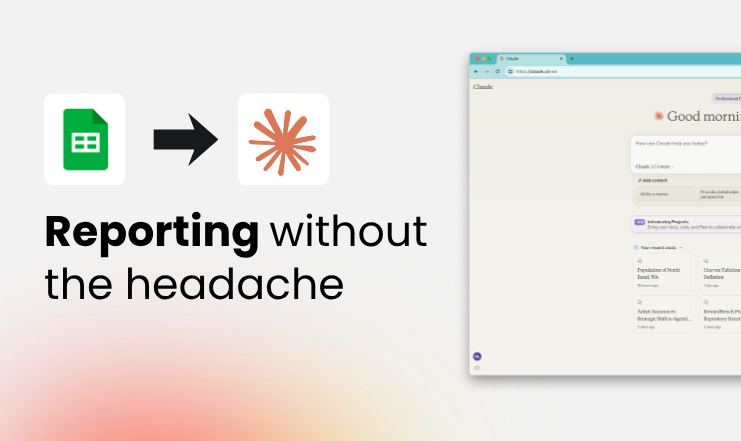
When you give Claude your raw exports, messy spreadsheets, and campaign data, here’s what it can do:
Turn raw numbers into readable summaries. Claude can take a table full of data across channels, campaigns, and audience segments and produce a clean performance summary that tells a story — in plain language, not spreadsheet-speak.
Surface the insights that actually matter. Instead of dumping every metric into a slide, Claude helps you identify the two or three things that truly explain performance — the kind of insight a senior analyst would flag.
Write next-step recommendations. Claude can produce clear action items: where to shift budget, which audiences to scale, which creatives to pause, what to test next week. Recommendations that finance, product, and leadership can actually act on — not just observe.
The result is less time in spreadsheets, faster turnaround on reports, and better conversations with the people who make decisions based on your data.
The Real Advantage
There’s a version of “AI in marketing” that just means automating boring tasks. That’s useful, but it’s not the real edge.
The real edge is knowing where Claude belongs in your workflow — and where it doesn’t.
Claude is genuinely strong at compressing research time, iterating creative based on data, and turning messy outputs into structured documents. But it’s not a replacement for brand judgment, strategic thinking, or the kind of creative instinct that comes from years of experience.
The marketing teams that pull ahead will be the ones who use Claude to move faster on the execution side — while keeping human thinking at the center of strategy, experimentation, and brand decisions. That’s AI-augmented work, not AI-replaced work.

Where to Start
You don’t need a full “AI transformation” to get value from Claude. The smartest approach is to start small: pick one workflow, prove the value, then expand.
Ask yourself one question this week:
Where would Claude save me the most time right now?
For most performance and growth marketers, the answer falls into one of three areas:
- Research — audience understanding, keyword strategy, competitor analysis, review mining
- Creative — ad copy, landing page variants, emails that improve based on performance data
- Reporting — weekly updates, stakeholder summaries, next-step recommendations
Pick one. Go deep. Treat Claude like a teammate you’re onboarding into that specific process — give it context, give it data, give it feedback. Once that workflow feels natural, expand into the next one.
That’s how you build a real, systematic AI-augmented growth engine — not by trying to automate everything at once, but by starting where the time savings are most obvious and working outward from there.
Ready to Turn AI Into Your Daily Marketing Teammate?
Stop experimenting with AI in isolation. Learn how to use it inside real campaigns, real workflows, and real performance environments.
Join the AI Powered Creative Digital Marketing Course and learn how to:
- Use AI for audience research, creative production, and reporting
- Turn performance data into better campaigns faster
- Work like modern growth teams already do
Learn all this inside a real studio. Work on live campaigns. Build skills you can use immediately.
Enroll Now and Start Building Your AI-Powered Marketing Workflow.