
Most people think the difference between average work and exceptional work is talent.
It is not.
The real difference is how deeply someone thinks before they act.
There are two types of people solving problems in the world. Both can be smart. Both can work hard. Both can execute. But one creates work that gets ignored. The other creates work that gets remembered.
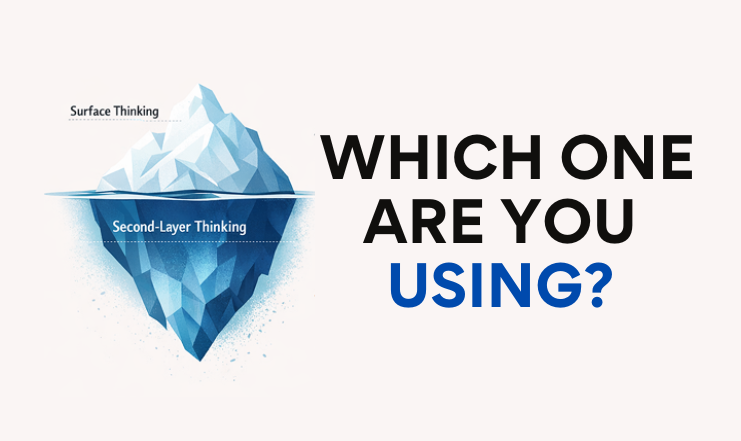
The difference is not skill. It is the difference between surface thinking and second-layer thinking.
A Simple Example: The Dying Houseplant
Imagine you buy a houseplant. Two weeks later, the leaves turn yellow and start drooping.
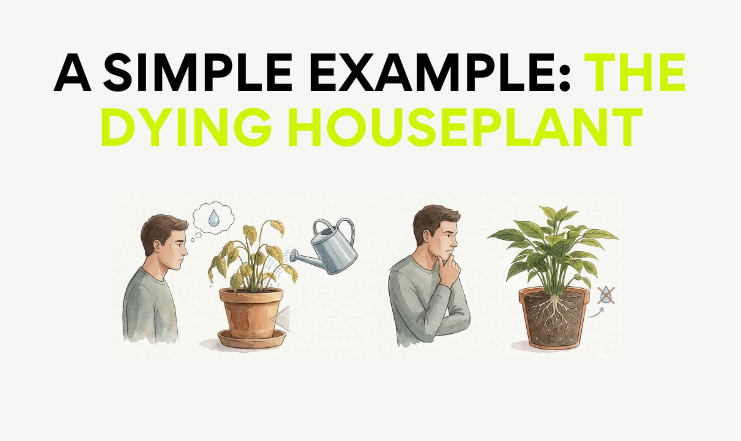
Most people immediately think: “The plant looks thirsty.” So they water it. The plant looks slightly better for a few hours. Then the next day, it looks worse. So they water it again.
But the real problem was not lack of water. The soil was already too wet. The roots were rotting. The plant was sitting in a dark corner.
The person solved the visible symptom. Not the real problem. That is surface thinking.
A second-layer thinker pauses and asks: Why is the plant yellow? Is it thirsty, or is it drowning? Is the problem the water, the light, or something else? Instead of reacting to the symptom, they diagnose the system.
In your career, “making the logo bigger” or “adding more features” is just watering a drowning plant. You are working hard, but solving the wrong problem.
Surface Thinking: The Default Mode
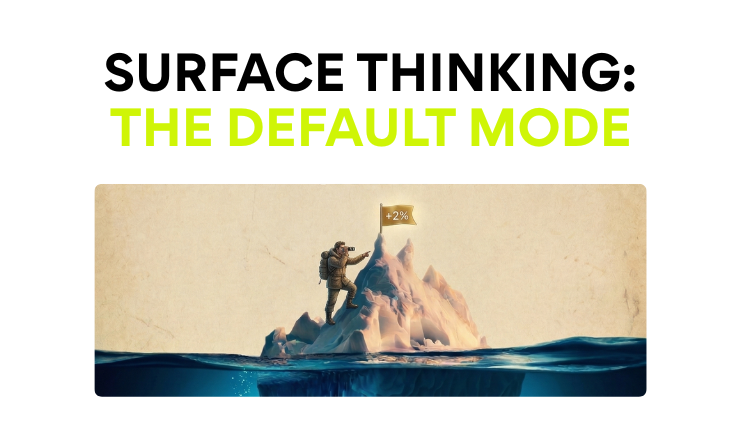
Surface thinking is what most people do automatically. It feels productive because you are doing something. But often, you are solving the wrong problem.
A designer is asked to make a mental health poster. They use calming colours, a brain illustration, and an inspirational quote. The poster looks nice — and exactly like every other mental health poster. Nobody notices it.
A marketer is told conversions are down. They change the button colour, make the headline bigger, add testimonials. Conversions improve slightly. But the real problem remains — people still do not understand why the product is different.
A founder sees people struggling with task management. They build another to-do list app. But people do not need another to-do list. They need help deciding what matters most.
The pattern is always the same. Surface thinking asks: What does the brief say? What does everyone else do? What is the fastest solution? It fixes visible problems instead of real ones. It copies patterns instead of questioning them.
Surface thinking is not lazy. It is just one layer too shallow.
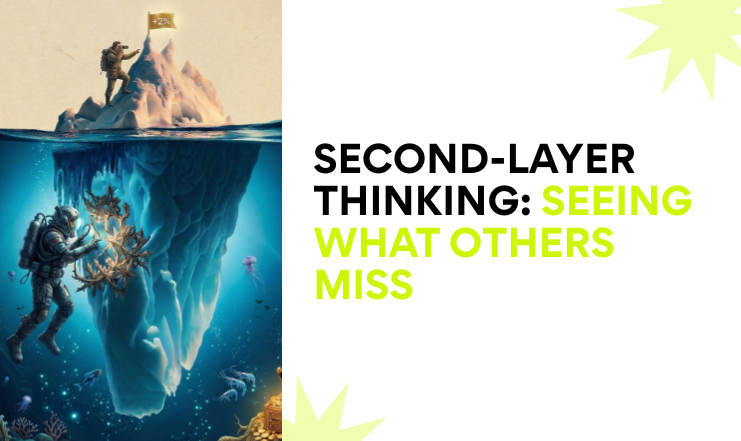
Second-Layer Thinking: Seeing What Others Miss
Second-layer thinking does not ignore the brief. It questions it. It pauses to understand the problem underneath the problem.
The mental health poster becomes more powerful when the designer asks: “Why do students ignore mental health events?” The answer is not because posters are ugly — it is because people feel ashamed to attend. The real problem is not awareness. It is stigma. So instead of “Join our mental health event,” the poster says: “You are not the only one. Let us talk.” Event attendance triples — not because the design was better, but because it solved the real problem.
The marketer asks: “Why are people not converting?” The answer is not because the button colour is wrong — it is because people do not understand what makes this product different from twenty others. Clearer messaging, not cosmetic changes. Conversions jump 40%.
The founder asks: “Why do people abandon to-do apps?” The answer is not lack of features — it is decision paralysis. So they build one app that asks a single question daily: “What is the one thing that matters today?” The product finds traction because it solves a problem people actually have.
Second-layer thinking asks: What is the real problem? What assumption are we making? What is everybody copying? What would happen if we did the opposite?
The Gap Between Two Creators
Imagine two designers receiving the same brief: design a recruitment campaign for a tech startup struggling to hire engineers.
The first designer follows the obvious route. Stock photos of smiling employees in modern offices. Headline: “Join a team that is changing the world.” The campaign looks professional — and exactly like every other tech recruitment campaign. Nobody applies. Every tech company says they are changing the world. The message is invisible.
The second designer asks: “Why are engineers not applying?” Not because they do not see job posts — because they do not believe this startup is different. They spot a hidden advantage: this startup lets engineers work on one project deeply instead of juggling five. The campaign says: “Stop context-switching. Build one thing that matters.” No stock photos. A single visual: a focused engineer with headphones. Applications increase 60% — not because it looked better, but because it said something true that others were not saying.
The first campaign is correct. The second campaign is memorable.
Same brief. Same talent. Different results.
Why This Becomes a Career Issue
This is where surface vs. second-layer thinking stops being about work quality and starts being about career trajectory.
Two people with the same years of experience end up in completely different places. Both started as juniors. Both worked hard. Both gained skills. But after five to seven years, companies start separating them.
One stays in execution roles — senior designer, senior editor, senior marketer. Competent. Reliable. But stuck.
The other moves into leadership — creative director, strategy lead, head of product.
Same experience. Different path.
The difference is not technical skill. It is not even work ethic. It is how they think before they act.
Leaders do not just execute well. They see problems differently. They question ideas. They make decisions that move things forward, not just complete tasks.
Second-layer thinking is the single quality companies look for when deciding who leads and who stays in execution roles.
Why Surface Thinking Feels Easier
If second-layer thinking creates better results, why does not everyone use it?
Because surface thinking feels easier, faster, and safer. And most people were trained to follow instructions, not question them.
Schools reward people for giving the correct answer. Jobs reward people for delivering work quickly. Very few systems reward people for pausing, questioning, and thinking deeper.
Here is the uncomfortable truth: surface thinking is our brain’s default mode. When faced with a problem, our minds automatically reach for the fastest pattern match. This is not laziness — it is efficiency. But in creative work, copying what we have seen before keeps you stuck. You solve problems the way you have always solved them. You make the same decisions your competitors make. Then you wonder why your results look the same as theirs.
Why This Matters More in the AI Era
AI is becoming very good at surface thinking. It can generate fast solutions, imitate styles, create variations, and optimise existing ideas.
But AI still struggles with second-layer thinking. It does not naturally question the brief. It does not automatically challenge assumptions. It does not instinctively see the emotional problem beneath the surface.
That is still human work. And that is exactly why second-layer thinking is becoming more valuable — because when everyone has access to the same tools, the real advantage comes from how you think.
Which One Are You Using?
When you work on something — do you immediately jump into execution? Or do you pause and ask:
- What is the real problem?
- What are people missing?
- Why is this not working already?
- What assumption is everyone making?
- What would make this impossible to ignore?
That pause changes everything.
The future does not belong to the people who execute the fastest. It belongs to the people who understand what is actually worth executing.
SPARK Is the Practice System for This
At Video Superstars Academy, SPARK is how students train second-layer thinking deliberately — so they do not just learn tools, but learn how to think beyond them.
Each step targets a specific layer of thinking:
- Spot — see the real problem, not just the visible symptom
- Probe — question the assumptions everyone else is accepting
- Adapt — look beyond your field for solutions others have not considered
- Reconstruct — organise your thinking into a clear, defensible direction
- Keep Iterating — refine until the work actually solves something real
The goal is not to make you slower. It is to make your first real decision sharper — so everything you execute after that is pointed at the right problem.
Because working hard on the wrong problem is still the wrong problem.
At Video Superstars Academy, SPARK is how students train this kind of second-layer thinking deliberately — so they do not just learn tools, but learn how to think beyond them.