

There are two kinds of people in every industry.
The first kind follows instructions well.
They learn the rules, understand the trends, copy what works, and stay inside accepted boundaries. They are competent. Reliable. Safe.
The second kind is different.
They ask questions other people are afraid to ask.
● Why are we doing it this way?
● Does this still make sense?
● What if the opposite is true?
● Why does everything in this category look and sound the same?
These people are not rebels because they want attention. They are rebels because they think
deeply. They are not anti-system. They simply understand the system well enough to know
where it is broken.
This is the rise of the knowledgeable rebel.
What Is a Knowledgeable Rebel?
A knowledgeable rebel is not someone who rejects systems out of frustration or ego.
They first understand the rules deeply. Only then do they decide which rules still make sense,
which are outdated, and which can be broken to create something better.
That is why knowledgeable rebels are different from people who are simply contrarian.
A contrarian disagrees with everything.
A knowledgeable rebel disagrees with the things that no longer make sense.
Every Breakthrough Came From Someone Like This
Think about the biggest breakthroughs in the world.
Gandhi questioned British rule — after studying law in London. Henry Ford did not accept that
cars had to be handmade slowly. Steve Jobs made technology simple — because he
understood complexity better than anyone. MS Dhoni redefined captaincy — only after
mastering cricket’s conventional strategies.
They all saw the same world as everyone else.
But they asked better questions.
And here is what most people miss: none of them were rebels out of instinct alone. They were
deeply knowledgeable first. The rebellion came second — and it came with clear reasoning, not
just feeling.
The Difference Between Guessing and Deciding
Most people make creative choices without real reasoning.
They choose a colour because it “looks good.” They structure a campaign because they “saw
something similar.” They make a video shorter because “people have short attention spans.”
But when someone asks why, they cannot explain it.
That is not decision-making. That is guessing.
A knowledgeable rebel can explain every important choice.
A normal designer may say: “I used blue because it felt professional.”
A knowledgeable rebel says: “I used blue because the audience is skeptical, the brand needs to
build trust quickly, and blue is associated with reliability and institutional confidence.”
One answer is instinct. The other is reasoning.
That difference changes everything. When you can explain your thinking clearly, clients trust
you. Managers trust you. Teams trust you. And that is how people move from execution roles
into leadership roles.
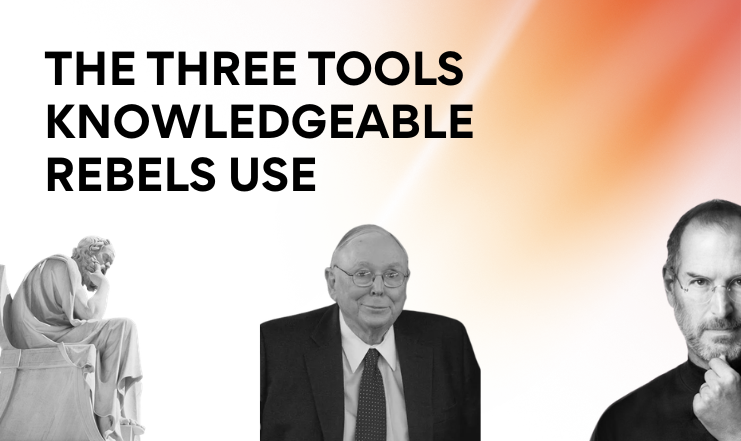
The Three Tools Knowledgeable Rebels Use
Great thinkers across history used similar methods. These three still work today.
The Socratic Method: Questioning as Craft
Socrates did not give answers. He asked questions — “What do you mean by that? How do you
know that’s true? What if we apply that logic here?” He did not argue. He exposed hidden
beliefs people did not know they were making.
Knowledgeable rebels do the same. They do not accept the first answer. They ask: “What if we
are solving the wrong problem?”
Inversion: Charlie Munger’s Thinking Tool
Charlie Munger built a fortune by thinking backwards. Instead of “How do I succeed?” he asked
“How do I fail?” — then avoided those patterns religiously.
Knowledgeable rebels use inversion constantly. Instead of “How do I make this design stand
out?” — ask “What makes designs forgettable, and how do I avoid that?” Flip the question. See
what everyone else misses.
Jobs’ Simplicity Principle
When Steve Jobs returned to Apple in 1997, consultants said: “Add more products. Compete in
more categories.” Jobs did the opposite. He cut 70% of Apple’s product line and asked: “What if
simplicity is the strategy?”
Four products. Obsessive focus. Revolutionary execution. Not louder. Clearer.
Think Like a Studio, Not a Freelancer
This is the shift that changes everything.
Freelancers wait for instructions. Studios compete for career-defining work.
Freelancers ask: “What does the client want?” Studios ask: “What does the client need that they
have not named yet?”
Knowledgeable rebels think like world-class studios. They apply this standard to every project
— not just the important ones. Because quality is a habit, not a switch you flip for special
occasions.
If you allow yourself to think shallowly on routine work, you will think shallowly when it matters
most. If you train yourself to think deeply on small projects, deep thinking becomes your default.

Why This Matters More Than Ever
For a long time, industries rewarded people for following instructions.
Learn the process. Follow the process. Deliver the work. That was enough.
But today, AI can follow instructions. Templates can follow instructions. Software can follow
instructions.
The people who will stand out are not the ones who execute the fastest. They are the ones who
can see what others miss, question what others accept, connect ideas from different fields, and
explain why they made the decisions they made.
In five years, there will be two types of professionals:
- Those who execute what AI suggests — replaceable
- Those who decide what AI should execute — indispensable
Knowledgeable rebels are in the second group.
How to Become a Knowledgeable Rebel
This is the good news.
You do not need to be a genius. You do not need natural creativity. You do not need ten years of
experience.
You simply need to practice thinking differently.
Question one assumption in your next project. Explain one decision with clear reasoning. Apply
one principle from an unrelated field.
Do that 10 times. Then 50 times. Then 100 times.
After 10 projects, you will start seeing problems differently. After 50, you will question ideas
instinctively. After 100, people will call you a strategic thinker — not because you became
someone new, but because you trained the skill until it became your identity.
SPARK Is the System That Builds This Identity
At Video Superstars Academy, we do not just want students to become better at software. We
want them to become better thinkers.
Because software skills may help you get your first opportunity. But thinking skills are what help
you grow, lead, and stay valuable.
That is why we teach SPARK — a system that trains people to think like knowledgeable rebels,
one step at a time:
- Spot — trains you to see problems others normalise
- Probe — trains you to question ideas others accept
- Adapt — trains you to connect ideas from different fields
- Reconstruct — trains you to organise complexity into clarity
- Keep Iterating — trains you to refine until good becomes great
You are not learning theory. You are installing an identity.
When second-layer thinking becomes your default, you stop being replaceable. You become the
strategist clients seek. The thinker teams trust. The leader organisations promote.
Not louder. Harder to ignore.
Explore the SPARK series:
- Why Tool Skills Alone Are Not Enough Anymore
- Surface Thinking vs Second-Layer Thinking: Which One Are You Using?
- What Is SPARK? A Thinking System, Not a Creative Trick
- From Executor to Strategist: How SPARK Helps You Stay Relevant in the AI Era
- What Are Companies Actually Hiring For Now?
At Video Superstars Academy, SPARK is how students train this kind of second-layer thinking
deliberately — so they do not just learn tools, but learn how to think beyond them.